1998 FIFA World Cup semi-final: France vs. Croatia
And Their Children After ThemThe 1998 FIFA World Cup semi-final between France and Croatia becomes both a dramatic sporting reversal and a rare spectacle of shared exhilaration in Heillange. France’s comeback turns bars and streets into a single cheering public; at L’Usine, it also brings Anthony Casati and Hacine Bouali together after a long absence, with the old possibility of violence briefly set aside.
The Match and Its Turning Point
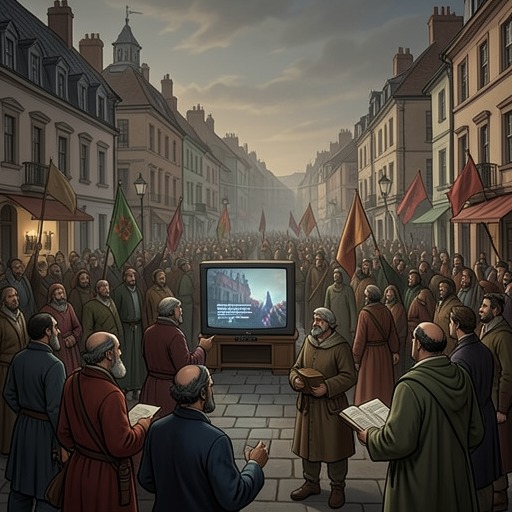
At quitting time, Hacine’s workmates head to the large screen at Renardière stadium, but he does not join them. He rides around town instead, moving through packed bars and crowds spilling onto sidewalks. With only one television channel, La Une, the match becomes a common focus, its commentators Thierry Roland and Jean-Michel Larqué familiar voices to the viewers. Hacine’s search for somewhere welcoming leads from one bar to another and finally back to L’Usine, where he has not been since his accident. The detour brings him into the central gathering rather than keeping him apart from it.
The game initially turns against France. In the forty-sixth minute, just after the teams return from the locker rooms, Davor Šuker takes a long pass from Asanović and scores for Croatia. The narration enlarges the shock into a national suspense: the country seems to hang by a thread. Šuker’s goal is not presented as an abstract scoreline. His pale face, white jersey patterned with red squares, outstretched arms, and cry of joy give the opposing team’s sudden advantage a sharp, unsettling physical presence.
Anthony arrives at L’Usine with his cousin, having searched through crowded bars near the blast furnace. They find Rudi and Manu, order a beer, and have barely arrived when Šuker scores again. The bar falls silent, and Rudi’s angry shout punctures the stunned pause. At that moment Hacine enters, orders a beer, and looks around the room. He recognizes Anthony, who recognizes him; neither greeting nor confrontation follows. Hacine turns his attention to the television, where the match is already changing again.
In the forty-seventh minute, Lilian Thuram advances up the pitch and scores, despite being known in the narration as someone who never scores. The response is instantaneous: the bar erupts, a table goes over, beer spills, and spectators jump, shout, and embrace. Anthony shakes Hacine in the shared excitement. Hacine raises both fists toward the sky. The two men, previously divided by a history of antagonism, occupy the same moment of celebration without resolving that history through conversation.
A Crowd Made in the Moment
The match continues amid drinking, smoking, and shouted exchanges from table to table. Anthony drinks heavily, buys rounds with his cousin, and treats Rudi; Rudi, looking more haggard than before, cries out at every French attack. Hacine drinks hard as well. These separate acts of participation make the bar’s collective enthusiasm concrete: the crowd is not simply watching together but eating, drinking, shouting, and reacting in close physical proximity.
At the seventieth minute, Thuram scores again, completing the comeback and settling the result. The narration describes the spectators as fused into a horde, with distinctions and outsiders seeming momentarily to disappear. It casts the celebration as a fantasy of national fraternity, one in which history, the dead, and old debts appear to have been erased. That language conveys the force of the scene while also marking its limits: the unity is produced by a shared match and a shared victory, not by any demonstrated resolution of the conflicts that preceded it.
Anthony’s brief trip outside to use the restroom brings the old conflict back within reach. His cousin spots Hacine at the bar and gestures toward him, but Anthony refuses to turn the evening into a fight. His decision does not erase their antagonism; it suspends action at a moment when the room’s excitement might otherwise have made confrontation easy. Anthony returns to the bar and orders another beer. France wins and reaches the final.
Victory in Heillange
At the final whistle, celebration spills out from the bars and takes over Heillange. Cars jam the streets in an endless procession, horns sound at random, and flags appear at windows and wave above the crowds. People paint their faces blue, white, and red; young people whistle and set off firecrackers, while people on the sidewalks toast one another with large cans of beer. Punks climb onto car hoods and jump from one vehicle to another through the traffic. The police look on indulgently as passersby stop to hug and kiss them.
The scale of the response matters to the town as well as to the match. Heillange seems to discover a reserve of strength and energy it had not recognized, and the victory briefly sweeps away the sense of crisis associated with three decades of bad luck. Champagne is opened at Heillange City Hall. The streets and public gestures extend the bar’s temporary togetherness into a town-wide celebration, though the narration presents this transformation as a momentary feeling rather than a lasting change in the town’s circumstances.
Reunion and Significance
The semi-final joins a public event to a private encounter without making either one disappear into the other. Anthony and Hacine recognize each other at L’Usine, but the match supplies their meeting with an immediate, shared focus. Hacine watches the screen; Anthony chooses not to fight him. Their raised fists and the crowd’s embrace offer a brief image of proximity, while the old antagonism remains unresolved. The scene’s restraint is important: a pause in violence is not presented as reconciliation.
France’s comeback also gives the episode its governing contrast. The country and the town are described as momentarily united, even as the crowd’s exhilaration depends on a sharply defined opposition between France and Croatia. The narrative lets the euphoria swell into an image of fraternity, then anchors it in particulars—one bar, spilled beer, a toppled table, a refused fight, and streets jammed with cars. The match matters not only because France reaches the final, but because its victory briefly makes a fractured town feel like a community and places two antagonists inside the same celebration.